EN
EN CN
CN
Indoor Steady-State Solar Simulation Testing System
Product description
Specifications
Download
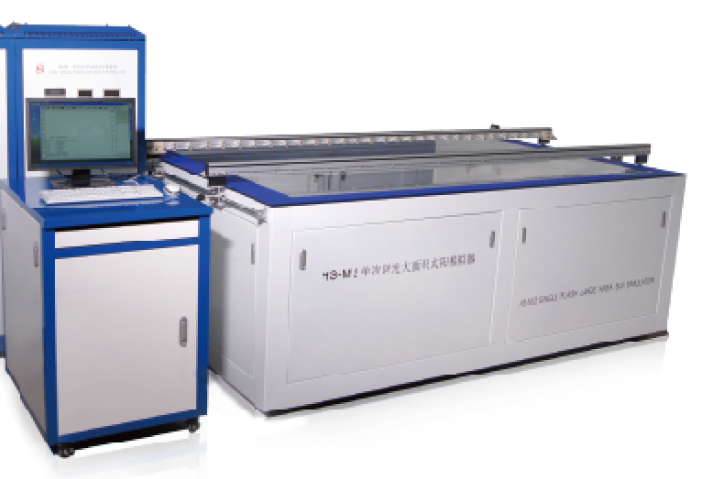
The steady-state solar simulation testing system is an artificial light source designed to simulate solar radiation. Indoor steady-state simulators have long been a mature solution for stabilization tests and hot-spot testing in photovoltaic laboratories.
In recent years, outdoor field testing has received increasing attention from customers. However, most outdoor validation tests are conducted at selected sites in different regions and are highly dependent on natural weather conditions. As a result, many factors remain uncontrollable, test cycles are long, and conclusions cannot be obtained quickly.
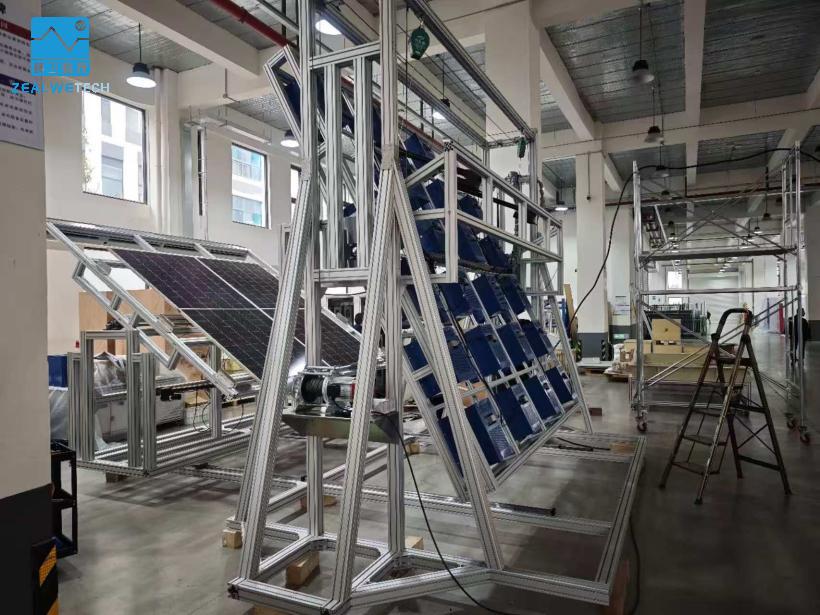
To address these challenges, we have developed an indoor steady-state solar simulation system for empirical testing. In this system, irradiance intensity is controllable, the irradiation angle is adjustable, and the distance between the light source and the test sample can be flexibly configured. By adjusting these parameters, the system can simulate the power generation performance of photovoltaic modules at different times of the day, such as morning, noon, and evening.
1. Uncontrollability of Outdoor Testing
When photovoltaic modules are tested in outdoor environments, they are exposed to various uncontrollable factors that can significantly affect test reliability, repeatability, and safety. The following sections analyze the key sources of uncertainty and their potential impacts.
1.1 Unpredictability of Environmental Conditions
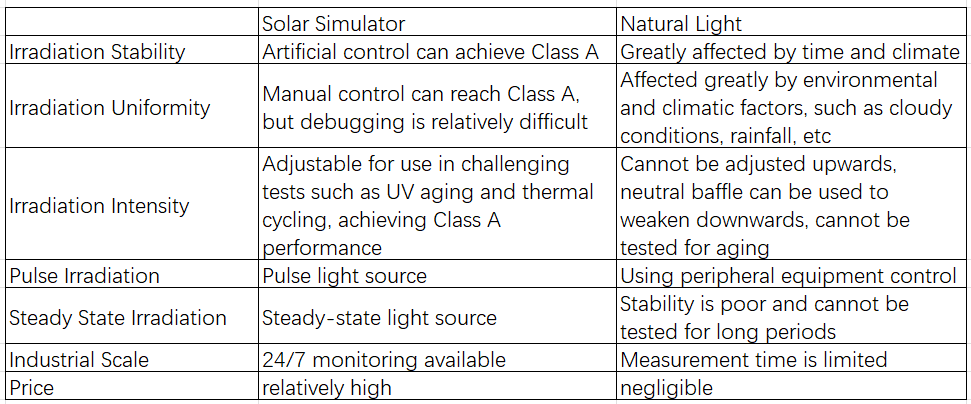
Outdoor testing is influenced by natural environmental conditions such as weather changes (rain, snow, wind speed), temperature fluctuations, solar irradiance variations, and atmospheric disturbances. These factors are difficult to control precisely and may introduce random noise, causing test results to deviate from actual performance. For example, in sensor or communication-related measurements, signal attenuation or drift may be caused by environmental changes, reducing data consistency.
1.2 Random External Interference Sources
Outdoor environments contain various unpredictable sources of electromagnetic interference (EMI), including other wireless equipment, power lines, and industrial facilities. These interferences may superimpose on test signals, leading to measurement errors or false triggering. For high-precision devices, satellite signals themselves may also be affected by space weather, further increasing test uncertainty.
1.3 Physical Safety and Accessibility Risks
Outdoor test sites may face risks such as unauthorized access, environmental damage, or human interference. Equipment theft, damage, or occupation of test areas may threaten the safety of test samples and result in test interruption or data loss.
1.4 Challenges in Repeatability and Reproducibility
Due to continuously changing environmental conditions, outdoor testing environments are difficult to reproduce accurately. Boundary conditions such as ground reflection or shading may vary between tests, making result comparison and fault diagnosis more difficult and reducing validation efficiency.
2. Proposed Solution
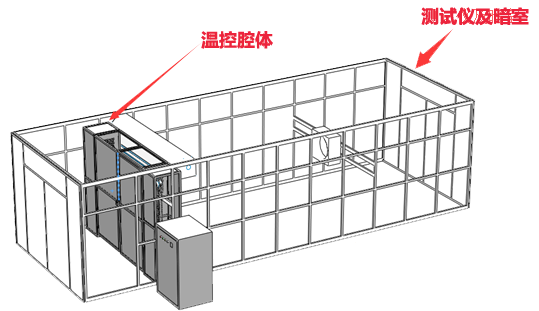
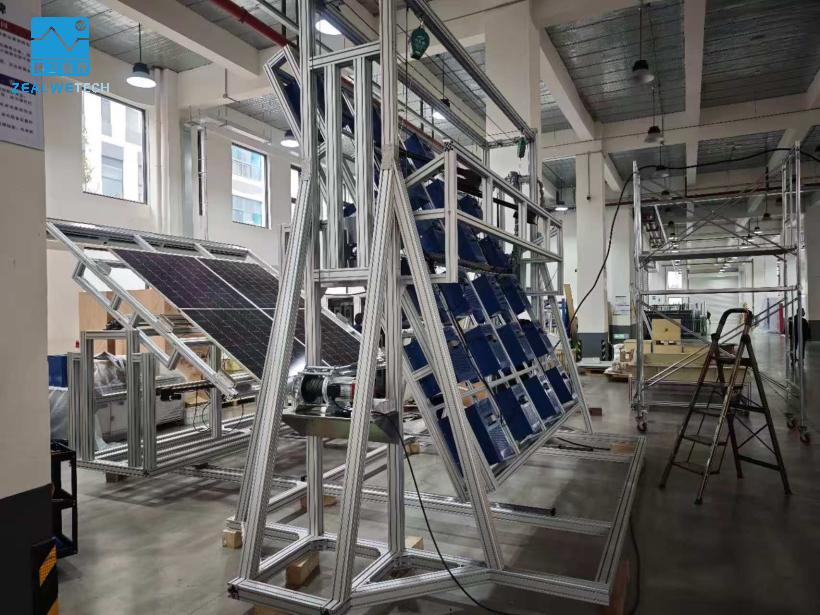
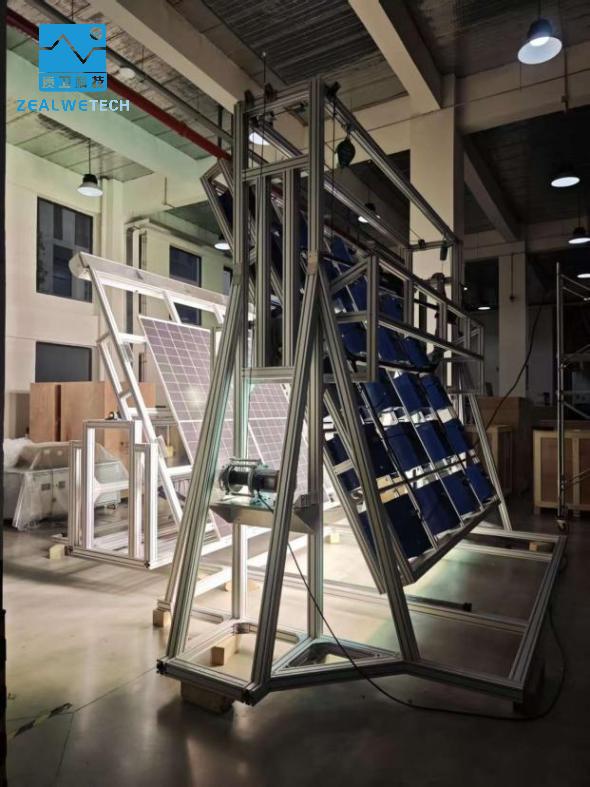
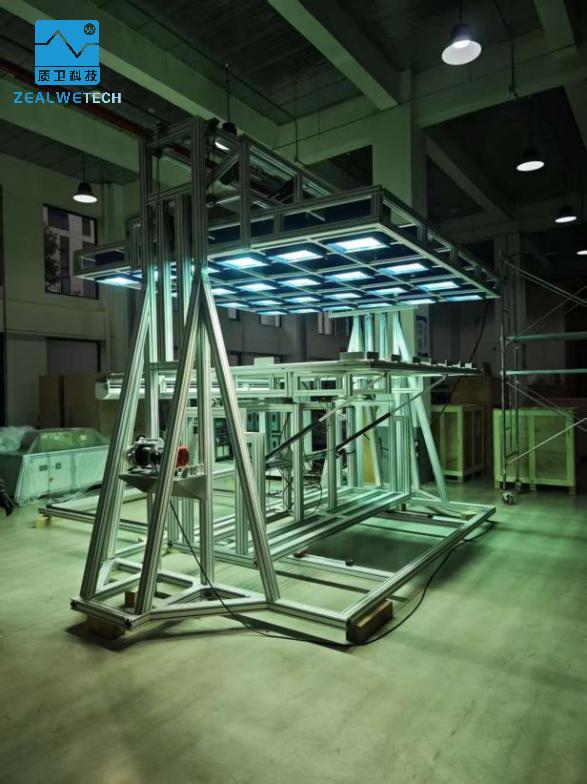
To eliminate the above uncontrollable factors, our company has developed and designed an indoor steady-state solar simulation system specifically for photovoltaic testing. The system consists of two main modules: a light source module and a test sample module.
By simulating the complete solar cycle from sunrise to noon and sunset, and by enabling adjustable and trackable control of the module angle in real time, the system improves operational convenience and enhances the overall testing experience for users.
3. Feasibility Testing and Verification
To verify that the steady-state solar simulation system is feasible and controllable in indoor environments, the following tests were conducted:
At an incidence angle of 30°, the measured irradiance was 346 W/m²
At 45°, the measured irradiance was 644 W/m²
At 60°, the measured irradiance was 1215 W/m²
At 90°, the measured irradiance was 1417 W/m²
At -60°, the measured irradiance was 1227 W/m²
At -45°, the measured irradiance was 663 W/m²
At -30°, the measured irradiance was 352 W/m²
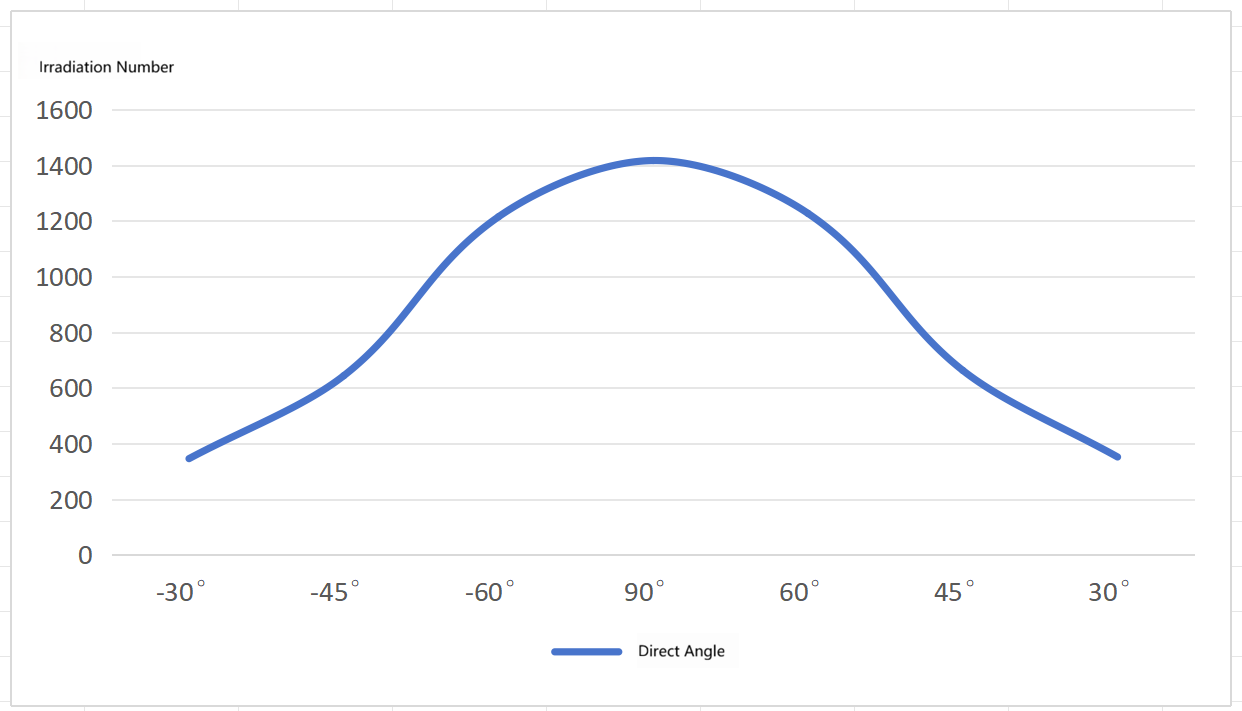
The irradiance simulation results reveal the variation trend of irradiance under different incidence angles. The data show that irradiance reaches its maximum value of 1417 W/m² at 0°, while the minimum value of 346 W/m² occurs at -30°. Overall, irradiance increases with angle and then decreases. Attention should be paid to the specific impact of angle variation on irradiance in order to optimize equipment configuration and testing processes.
4. Conclusion
Based on the above testing and verification results, the steady-state solar simulation system has been proven to be feasible and controllable for indoor photovoltaic module testing. It provides a practical solution for rapidly obtaining daily power generation data of photovoltaic modules under simulated solar conditions.
- File name Release date Ooperating